India’s education system is decentralized by design. Scholarships are managed at the state level (like Karnataka’s SSP), while university administration runs through institution-specific ERP systems. Then the central government layers in platforms like DigiLocker, the National Scholarship Portal (NSP), and the ABC (Academic Bank of Credits) system on top of everything.
Each of these serves a distinct purpose. The problem is that they were built at different times, by different departments, and they don’t always talk to each other cleanly. That’s why a student can have their scholarship approved on SSP but still see a payment failure because their Aadhaar isn’t NPCI-seeded at their bank — a completely separate system.
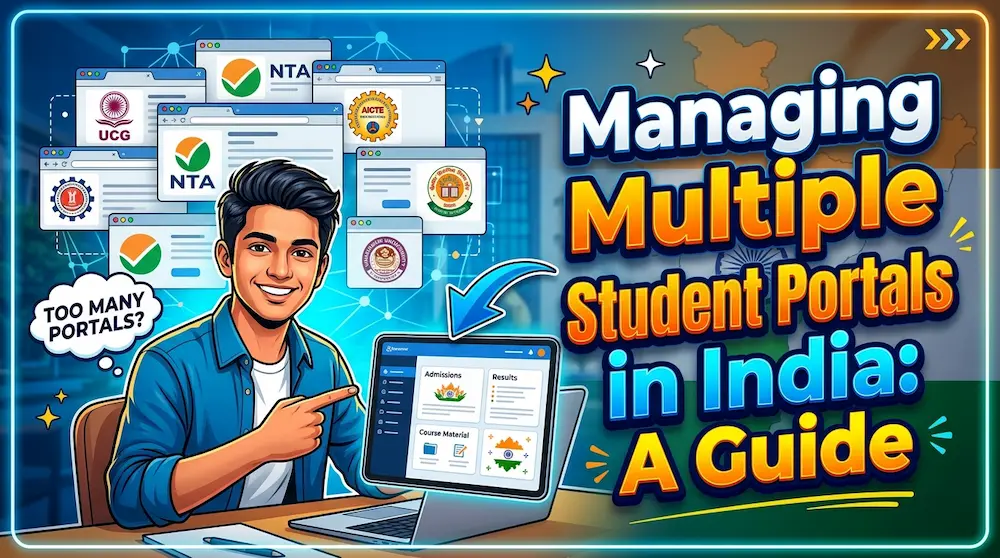
Understanding that these platforms are connected but not integrated is the first mental shift every student needs to make.
The Three Layers Every Student Deals With
Layer 1: National Identity & Registration
This is your foundation. Your Aadhaar number sits at the center of everything. Before you can apply for any scholarship or access any university portal, your Aadhaar must be:
- Linked to an active mobile number
- Seeded to your bank account through NPCI (for any DBT payment to reach you)
- Updated with accurate name and date of birth (matching your school certificates)
A mismatch here will create chain-reaction errors across every portal you touch — SSP, DigiLocker, NSP, and university ERPs alike.
Layer 2: National Scholarship & Credit Systems
Once your Aadhaar is clean, you need to set up your presence on national platforms:
- NSP (National Scholarship Portal): For 2025-26, even state scholarship portals like Karnataka’s SSP require an OTR (One-Time Registration) number from NSP before final submission. Get this first, before anything else.
- ABC ID / APAAR ID: Universities are now mandating that students link their Academic Bank of Credits ID to their institution’s records. This ID, generated via DigiLocker, stores your credits nationally so they are recognized if you transfer universities or apply abroad.
Layer 3: State & Institution-Level Portals
This is where the day-to-day action happens. Your state scholarship portal handles your financial support. Your university’s ERP handles everything from exam forms and fee payments to admit cards and result checking.
For example, students at AKTU-affiliated colleges in Uttar Pradesh manage their semester-to-semester academic life through AKTU ERP, which handles exam form submissions, internal marks, carry-over paper registrations, and now the mandatory ABC ID synchronization — all from one dashboard. The structure is similar to what SSP students in Karnataka experience, just applied to the university administration side rather than scholarships.
Knowing which portal handles which task stops you from wasting time searching in the wrong place.
Common Mistakes That Cost Students Months
1. Waiting for SMS OTPs that never arrive
Every major portal now uses OTP-based authentication. If your registered mobile number has DND (Do Not Disturb) enabled, SMS OTPs will frequently fail silently. Most portals in 2025-26 have added an email OTP fallback. Always register with both a phone number and an active email address, and check both inboxes when logging in.
2. Making double payments during high-traffic windows
Exam form season and scholarship submission periods bring lakhs of students to the same servers at the same time. Payment gateways often show “Failed” status even when the money has been deducted. Before paying again, wait 48 hours and check your bank statement. Most portals run a batch reconciliation that corrects the status automatically. Paying twice creates a loop in the system that can delay your form verification by weeks.
3. Using the wrong credential for the wrong portal
This sounds simple, but it trips up thousands of students every cycle. University enrollment numbers, roll numbers, SSP IDs, and NSP registration numbers are all different identifiers for different systems. Keep a written record (or a secure notes app) of which ID belongs to which portal. Never assume your roll number works where your enrollment number is required.
4. Skipping document verification steps
Both the SSP portal (via e-Attestation) and university ERPs (via profile verification) have intermediate steps where a nodal officer or college administrator must approve your records before the system proceeds. Students often submit their application and assume it’s done. It isn’t — until a human on the other side clicks “Approved,” your file is in a queue. Check your status every 3-4 days and follow up with your college coordinator proactively.
A Simple System That Works
Given the complexity, here’s a practical approach that keeps things manageable:
Build a “Portal Map” document for yourself. One page, nothing fancy. Write down every portal you use, the correct URL (bookmark the official one only — phishing sites are common), your unique login credential for that portal, and what tasks it handles. Update it whenever something changes.
Handle your Aadhaar layer first, once a year. At the start of every academic year, verify that your Aadhaar mobile link is active, your bank is NPCI-seeded, and your name matches your certificates. Fixing this proactively takes thirty minutes. Fixing it after a rejection notice can take thirty days.
Set calendar reminders for deadlines, not just for the final date. The final submission deadline is not the actual deadline. Your college nodal officer needs 5-7 working days before the portal closes to verify your documents. Work backward from the official last date and treat your personal deadline as a week earlier.
Use desktop browsers for critical submissions. Most government portals were designed for desktop environments. On mobile, buttons sometimes disappear, forms don’t load completely, and payment pages time out. If a critical action is failing on your phone, switch to a laptop with Chrome or Firefox in desktop mode before trying again.
The Bigger Picture
The Indian government’s push toward digitization of student services is genuinely positive — faster disbursements, verified credentials, reduced paperwork. The friction students face today is largely transitional. As Aadhaar integration matures and platforms become better connected, the experience will improve significantly.
For now, the students who navigate this system best are the ones who treat it like a skill to be learned rather than a bureaucratic wall. Once you understand the logic — Aadhaar as the base, national systems in the middle, state and institution portals on top — the chaos starts to make sense.
Stay organized, verify early, and never assume a submission is complete until you see a confirmed acknowledgment number.